

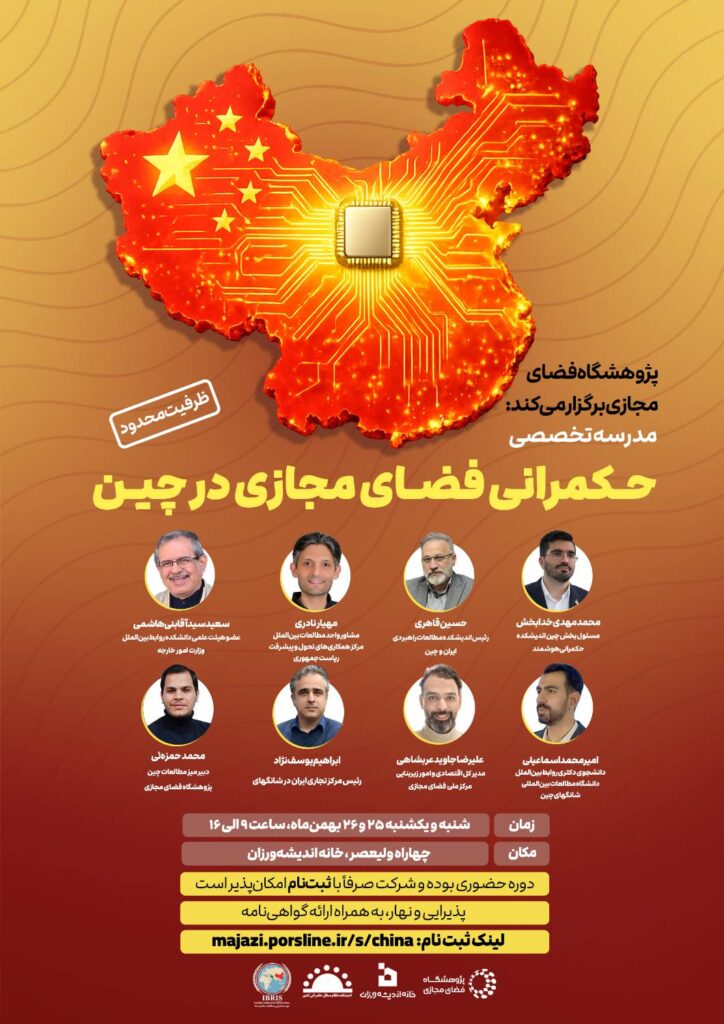
The “China Digital Governance School” aims to explore new dimensions of governance in the digital age and examine the relationship between technology, politics, and power in China, and will be held by the Cyberspace Research Institute under the Cyberspace Center of Excellence on February 15 and 16 from 9:00 to 16:00. This educational-analytical course, with a special focus on topics such as cyber governance, cyberspace security, digital economy, policymaking of new technologies, and China’s role in shaping the global digital order, attempts to present a comprehensive picture of the challenges and opportunities of governance in the digital age for developing countries, especially countries in the global South. The analysis of the “China Cyber Governance Model” and its implications for power structure, national security, economic development, and cyberspace management are among the most important topics examined in the meetings of this school. This approach allows for a comparative comparison between China’s experience and the strategic needs of the Islamic Republic of Iran in the field of digital governance. The Iranian Institute for Belt and Road Studies, through its active participation in this course and through the presence of two of its directors and researchers, plays an effective role in enriching the scientific content of the Digital Governance School.
Eng. Ebrahim Yousefnejad, Head of the Islamic Republic of Iran Business Center in Shanghai and Head of the Iranian Institute for Belt and Road Studies, will explain the operational dimensions of digital governance, technological interactions, and strategic cooperation opportunities between Iran and China in the field of digital economy, relying on his practical experiences in China’s economic and technological ecosystem.

Also, Dr. Amir Mohammad Esmaili, Secretary General of the Institute and researcher in the field of China Studies and a PhD graduate in International Relations from Shanghai International Studies University, along with Engineer Yousefnejad, will examine “China’s cyber governance model” and its challenges and opportunities for countries in the Global South with an analytical and theoretical approach.

The participation of the Belt and Road Institute for Iranian Studies in the Digital Governance School reflects the institute’s strategic approach to linking China studies with emerging issues of governance and technology. In addition to transferring China’s practical and theoretical experiences to the country’s academic environment, this presence provides a platform for deepening specialized discussions on the future of digital governance in Iran and designing local models based on successful global experiences.