
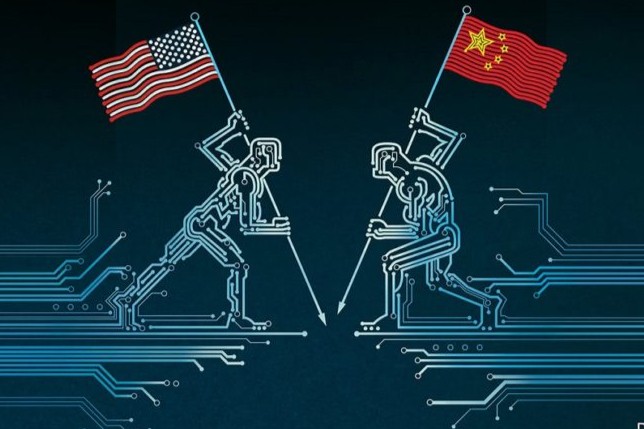
In the decades following World War II, the United States has consistently been recognized as the global hub of technology and innovation. With the establishment of companies like Google, Microsoft, Apple, Amazon, and Facebook, known as the five tech giants, it plays a hegemonic role in this field. However, since the early 2010s, China, through extensive investment in telecommunications and artificial intelligence and a shift from technological dependence to self-reliance under the “Made in China” [1] program, has managed to become a prominent player in this sector, challenging the world’s unilateral reliance on American technologies and standards.
This process, marked by extensive investments from Chinese companies, primarily Huawei and ZTE, across the ASEAN region, the European Union, and other parts of the world, and accompanied by innovations such as fifth-generation internet, not only secured the share of Chinese technologies in competition with American tech companies but also paved the way for shaping a new geopolitical landscape in confronting the hegemony established by American companies. This paper, developed based on a critical geopolitical theoretical approach, addresses how this conflict contributes to shaping new equations in
the geopolitical sphere, and how it plays a role in the formation of new regional and global alliances and discourses?
Critical Geopolitics and the Technological Rimland
What is referred to as “Critical Geopolitics” [2] in the present era is the result of a shift in approach to geography and territorial features as determinants of state power. The concept of geopolitics was initially based on examining the effects of geography on politics, especially at the international scale. However, after the information revolution in the 1990s and post-structural approaches to politics, with the idea that technology, culture, and economics are pivotal factors in shaping state power in the territorial sphere, critical geopolitics emerged as a new approach. Within this framework, nation-states are not the only legitimate units of geopolitical analysis; private companies, new technologies, and capital markets, including cryptocurrency, play a significant role in altering geographical equations.
If, in the past, geopolitics was a method for foreign policy analysis that sought to understand, explain, and predict the behavior of international actors based on geographical variables such as location, size, climate, topography, demographics, and natural resources, in the new approach, geopolitics is a factor that, along with soft factors such as discourses, narratives, representations, and access to information and communication, redefines political and geographical equations. Accordingly, the technological conflict between the United States and China is not merely a competition for access to resources and territorial control, but rather a struggle over meaning, narrative, and intersubjective perceptions regarding the future of the digital world. In this context, each of the pivotal powers, China and the United States, in the form of a technological cold war, strives to present a discourse aligned with its own interests to the world and expand its sphere of influence. Within the framework of the grand narratives presented by each side, the US presents technology in line with the values of freedom, transparency, and market economy, while China views technology as a tool for development, national power, and social management.
Therefore, what has emerged as the technological rimland and a re-recognition of geopolitics with the formation of concepts like techno-geopolitics, in fact, refers to new alliances based on internet technology and core technologies such as artificial intelligence, chips, semiconductors, 3D printers, and quantum technologies. As the American theorist Nicholas Spykman points out in his reconstruction of Mackinder’s theory, global power lies in controlling the Eurasian rimland, which in the digital age can be described as the technological rimland. This reinterpretation not only refers to regions whose control facilitates access to digital networks, data, and technological infrastructures but also provides a picture of the future equations of international relations in the form of a technology equation between East and West. The technological rimland is divided into four sections:
- Taiwan and East Asia: as the hub for semiconductor and chip production and an important region for technology standardization.
- India and Southeast Asia, centered around the “Alliance of Six” including Malaysia, Indonesia, the Philippines, Cambodia, Laos, and Vietnam: as the global telecommunications hub, submarine cable route, and a massive digital technology market.
3. The Middle East and Africa: as a location for internet investments in startups and big data, and also as emerging markets.
- Eastern and Central Europe: as an arena for conflict over setting global standards, especially in artificial intelligence and startups.
Therefore, control over these regions means control over the flow of global data, capital, and innovation.
The United States and China: Two Different Strategies
The technological conflict between the United States and China, referred to as part of the Second Cold War, seriously intensified after Trump came to power in 2016. This marked a shift in US foreign policy, adopting an offensive realism instead of Obama’s defensive realism, aimed at reconstructing the global neoliberal order in America’s interests. In this context, the United States shifted its cyber strategy from countering the Russian threat to China on August 1, 2018. On the pretext of Huawei circumventing Iranian sanctions, it arrested the company’s CEO, Meng Wanzhou. Furthermore, by imposing unprecedented tariffs in the form of an economic war – which was contrary to free trade laws – it impacted the entry of Chinese technologies into the US and Europe. By securitizing the activities of the Chinese application TikTok on the pretext of espionage, it adopted a strategy of securitizing Chinese technologies. The reciprocal policies of the US and China in the technological conflict can be examined at four levels:
1. Securitization of Technology
With Trump’s ascent to power, the United States’ cyber strategy changed in 2018. Dan Coats, the US Director of National Intelligence, announced in September 2018 that “the core objective of the cyber strategy of China, Russia, Iran, and North Korea is to steal information, influence citizens, and disrupt critical US infrastructure.” In response to this, China developed a comprehensive national power plan centered on three aspects: science, technology, and cultural influence. In 2019, it approved the “Defense White Paper” [3] as China’s core strategy in technological competition with the United States. According to this, instead of the conventional binary logic between war and peace in international relations, China’s foreign policy apparatus describes international relations with “evolving combinations of cooperation, compromise, confrontation, and conflict” [4]. This, unlike the Western approach, makes no distinction between peace and war on the one hand, and between military and civilian spheres on the other, and utilizes a military-civilian integration policy aimed at the widespread development of technology.
2. Formation of Cyber Alliances
The most serious US strategy in confronting China’s dominance in the technology sector has been the formation of regional and global cyber alliances to encircle and control China’s sphere of influence. This includes the reconstruction of the Quad in 2017 as a regional strategy and the formation of an integrated cyber alliance relying on the “Five Eyes” [5] alliance as a global strategy. The US, through the “Cyber Flag” [6] discourse, in the form of week-long exercises in 2019 and 2020, and by providing a handbook titled “Joint Cyber Security Advisory” [7], sought to create a global alliance against China’s influence in the ASEAN region. Although this policy became a significant challenge for China in the South China Sea, China, by adopting a policy of “strategic dependence” [8] and reducing technology prices, managed not only to maintain its ties with key countries of the two aforementioned alliances, such as India and Britain, but also prevented the development of a regional alliance against itself by investing in the telecommunications and technology sectors of six countries: Malaysia, Indonesia, the Philippines, Cambodia, Thailand, and Vietnam. Therefore, China’s core strategy in confronting the United States is to create strategic economic dependence and long-term cooperation in the technology sector, aiming to establish a political-economic balance with the United States by relying on military capabilities and the logic of military-civilian integration.
3. Using Information Influence to Reduce Allies’ Dependence
The third level of US strategy in confronting China involves using the informational influence of the CIA and the US National Security Agency to impact the political decision-making of the Five Eyes alliance countries and the European Union towards sanctioning Chinese technologies. The most significant effort in this area, carried out in cooperation with John Sawers, former head of MI6 and senior advisor at the “Henry Jackson Society” [9] think tank, a hub for liberal development in Britain, in collaboration with the United States, is the plan to break China’s supply chain. This plan was presented in 2020 under the title “Breaking China’s Supply Chain: How the Five Eyes Alliance Can Detach from Strategic Dependence” [10]. According to this report, published on May 19, 2020, the Five Eyes alliance countries are highly dependent on Chinese technologies, and actions should be taken towards de-communization and the development of democracy and liberalism in these countries.
This report indicated that the Five Eyes alliance countries were dependent on China for 831 categories of goods: Australia in 595 categories, Canada in 367, New Zealand in 513, Britain in 229, and the United States in 414. Consequently, these countries have developed a strategic dependence on Chinese products, which necessitates action to eliminate this dependence through a policy of decoupling. A key protocol in this policy was to operationalize the plan for exiting the European Union (Brexit) to separate Britain from China and the EU, defending it as a liberal democracy against “dictatorial” China and the “corrupt” European Union. While the main goal of this policy was to leverage Britain’s political and economic power to change or close economic gaps between Britain and Germany, the Netherlands, France, and Italy, and between Britain and China, this policy failed due to Britain’s excessive dependence on China and, to some extent, on the European Union.
4. The New Rimland and Trade War with China
The final part of this conflict concerns the tariff war aimed at dominating the technological rimland. The Trump administration initiated a trade war with China in August 2018, urging the international community to ban next-generation technologies from Chinese tech giants Huawei and ZTE due to espionage allegations and national security concerns. However, sanctions against China were not very effective. This was because China had previously laid the groundwork for economic dependence of countries at regional and global levels. The Chinese government, by implementing long-term contracts and Huawei’s £2 billion investment in Britain, collaborating with and acquiring bankrupt European companies like Sony Ericsson of Sweden and Nokia for the development of next-generation internet technology in the European Union and Africa, and investing over $3 billion in the Philippines, Thailand, Indonesia, Malaysia, and Cambodia, effectively neutralized US sanctions. Consequently, apart from Australia, Japan, and New Zealand, other countries did not prioritize the securitization of Chinese technologies. In fact, the Chinese government, with its strategy of strategic dependence in economics and technology, not only neutralized US sanctions but also managed to form a Digital Belt and Road alliance with the aim of creating a balance with the West.
Conclusion
This conflict demonstrates that the core component in determining international equations in the 21st century is technology, and any country with greater dominance over the technological rimland will play a more decisive role in redefining the global order. In this regard, China and the United States have each adopted their unique strategies in forming regional and global alliances. China, by pursuing a policy of strategic dependence and price reduction, seeks to maintain its markets, while the United States, through the securitization of Chinese technologies and geopolitical decoupling policies, including cooperation with the Five Eyes alliance and the reconstruction of the Quad, seeks to create a rupture in China’s Belt and Road Initiative. The central issue in this area is which narrative and discourse hold more appeal for countries, and how each country in the future multipolar system will create a technological balance between the Chinese and American models. It is also very important which emerging technologies the United States and China consider as their focus areas and which they cede to their rival.
References
Buchanan, B., & Imbrie, A. (2022). The new fire: War, peace, and democracy in the age of AI (pp. 157–186). MIT Press.
Cheng, D. (2019). Chinese views of information and implications for the United States. In P. Peterson (Ed.), Chinese strategic intentions: A deep dive into China’s worldwide activities. A Strategic Multilayer Assessment (SMA) white paper.
DeNardis, L. (2020). The internet in everything: Freedom and security in a world with no off switch (pp. 165–176). Yale University Press. https://doi.org/10.2307/j.ctv11sn32r
Feigenbaum, E. A. (2019, July 12). In Asia, disruptive technonationalism returns. Carnegie Endowment for International Peace. https://carnegieendowment.org/2019/07/12/asia-disruptive-technonationalism-returns-pub-79412
Orinx, K. (2023). US cyber strategy in the Indo-Pacific. In O. Turner, N. Nymalm, & W. Aslam (Eds.), The Routledge handbook of US foreign policy in the Indo-Pacific. Routledge.
Wirtz, J. (2014). The cyber Pearl Harbor. In E. Goldman & J. Arquilla (Eds.), Cyber analogies. Monterey, CA: Naval Postgraduate School.
Wong, P. N. (2022). Techno-geopolitics: U.S.-China tech war and the practice of digital statecraft. Routledge. https://doi.org/10.4324/9781003047100