
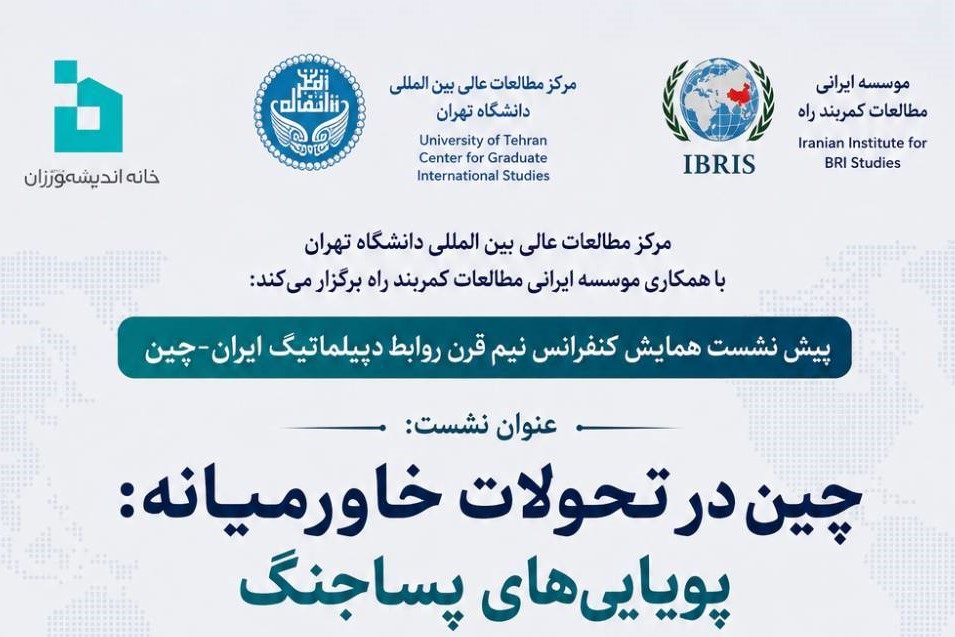

Title: China in the Context of a Changing Middle East: Post-War Dynamics
Organizers: Center for Graduate International Studies (CGIS) of University of Tehran & The Iranian Institute for Belt and Road Initiative Studies
Speaker: Professor Wang Jin, Director of the International Strategic Research Center and Council Member of the Chinese Association for Middle Eastern Studies
Session Chair: Ahmadreza Yousefvand, Research Secretary at the Iranian Belt and Road Initiative Studies Institute
Date: September 1, 2026 (10/06/1405 SH)
Pointing out that, quite naturally, post-war conditions worldwide differ from those preceding them, Professor Wang stated that the confrontation between the Islamic Republic of Iran, the United States, and the Zionist regime has created an environment in which Middle Eastern nations feel sympathy toward Iran and hold a favorable view of it. Consequently, this has elevated Iran’s popularity among the peoples of the region. On the other hand, however, such consensus and alignment are absent among government officials of the Persian Gulf littoral states and the wider Middle East due to conflicts of interest with Iran and their reliance on the West, resulting in a distinct dichotomy between nations (publics) and states. He further characterized Iran’s resistance against the West during the wartime period as admirable and courageous. He explained that despite Hamas being defeated in Gaza and Hezbollah being severely weakened in Lebanon, Iran has managed to stand firmly against the West in a remarkable manner, bogging the West down in the Middle East.
Regarding China’s relations with regional countries, Professor Wang noted that a certain duality has arguably emerged between China’s economic interests and its geopolitical interests in the region—a divide that China adroitly strives to balance. To elaborate, China has cultivated a broad spectrum of mutual interests with regional states within the framework of its expansive economic ties and under initiatives such as the Belt and Road Initiative (BRI), inextricably linking Beijing’s interests with these countries. This occurs while China continues to focus on enhancing the qualitative development of its country and population, thereby reinforcing the critical importance of sustained economic engagement. The Gulf Cooperation Council (GCC) member states serve as China’s primary crude oil suppliers with lower operational risks, wealthy financial partners, and export destinations for Chinese advanced technologies (such as 5G telecommunications, new energies, and artificial intelligence) within frameworks like Saudi Arabia’s Vision 2030. Conversely, in the long term, China’s geopolitical interests converge with those of Iran across multiple dimensions. For China, Iran represents geopolitical strategic depth and an independent counterweight in containing American hegemony. Iran’s geographic position along the Eurasian overland crossroads and its independent posture provide Beijing with a vital and irreplaceable safety margin in the long-term calculus of its strategic competition with the West—exemplified by the 25-Year Strategic Cooperation Agreement.
He also acknowledged that, beyond Washington’s malicious objectives in confronting Iran, the conflict in the Middle East can be regarded as part of a broader puzzle aimed at containing China, given that Iran is considered the gateway to Eurasia—a role of immense significance in the shifting international order. Nevertheless, risks stemming from the military footprint of extra-regional powers in Taiwan and the South China Sea constrain China’s strategic agency in the Middle East. Here, he pointed to an identity rift, noting that while the Chinese people consider Taiwan an integral part of their homeland, many in Taiwan—swayed by Western narratives and approaches—no longer identify as Chinese, a mindset that historically and traditionally did not exist among the Taiwanese population. Professor Wang maintained that in the event of a confrontation in the region, Japan and the Philippines would act against China and in favor of Taiwan’s independence in terms of logistics and military support. This dynamic has compelled China to concentrate its military focus predominantly on Taiwan-related affairs. Consequently, these factors have fueled debates and divisions among Chinese strategists regarding the appropriate degree of support for Iran. He believed, however, that should conditions for cooperation be facilitated and the necessary consensus emerge within Iran, there would be room to expand such support.
With respect to the Mecca Agreement, Professor Wang assessed that it fails to sufficiently integrate the shared interests of the involved parties (Pakistan, Saudi Arabia, and Turkey) and, as such, cannot currently be accorded substantial credibility or strategic weight.