
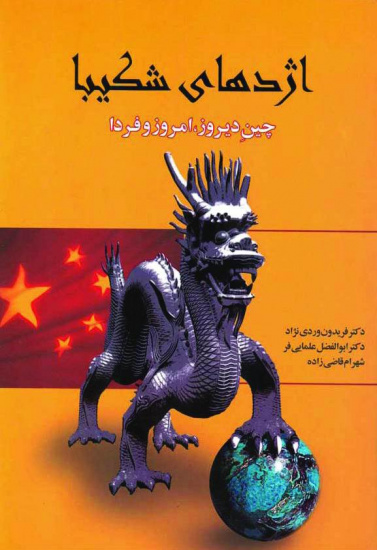
The book “The Patient Dragon: China Yesterday, Today, and Tomorrow” by Fereydoun Verdinejad, Abolfazl Ulmaeifar, and Shahram Ghazizadeh is a comprehensive study of China’s history, thought, and contemporary developments. In this work, the authors attempt to examine how China gradually transitioned from a traditional, agricultural society to an industrial, global power in light of historical, philosophical, and political contexts.
The book is organized into five parts and ten chapters, covering China from ancient times to contemporary times. The first three parts are dedicated to the history and thought of China in ancient, medieval, and contemporary times, and the last two parts, with a more analytical perspective, examine China from the 1949 revolution to the present era from a political, economic, and social perspective. The authors believe that a proper understanding of the path of China’s current development is not possible without understanding its historical and cultural roots; hence, history, thought, and politics are narrated in this work in a continuous and intertwined manner.
In the book’s preface, Fereydoun Verdinezhad recalls the process of the collapse of communist systems in the 20th century and introduces the People’s Republic of China as a “historical exception”; a country that, unlike the Soviet Union and its satellites, was able to maintain its political structure in the face of the great wave of globalization and at the same time turned to modernization and industrialization. By carefully analyzing this experience, he emphasizes the intelligence of China’s political elite, the historical and cultural background of this land, and its ability to benefit from international developments. According to the authors, during the 1980s and 1990s, China, by testing a specific model of development, took a path in which the Red Revolution, ideology, and realism became a unique combination.
The book traces the evolution of the Chinese elite from a generation of ideological revolutionaries to technocratic and pragmatic managers. The authors show how the gradual distancing of the political system from purely ideological concepts led to the emergence of innovative classes and economic growth. As a result, relying on a pragmatic approach, China was able to redefine its place in the international system and take steps towards achieving a “new identity”; an identity based on historical patience, civilizational self-confidence, and intelligent use of global conditions.
The historical sections of the book provide a detailed account of the evolution of thought and government in China: from the ancient Shang and Qin dynasties to the feudal era, from the Confucian system and bureaucratic examinations to the philosophical schools of Legalism, Taoism, Yin and Yang, and Utilitarianism. In this narrative, philosophy is not an abstract concept but rather the infrastructure for the continuation of China’s social and political order. Then, in the medieval and modern eras, with the arrival of Buddhism, the expansion of the Silk Road, and interaction with foreign powers, Chinese thought undergoes new developments that ultimately lay the groundwork for the political renaissance of the twentieth century.
The final chapters examine contemporary history and China after the 1949 revolution. The book takes an unbiased approach to the land reform policies, the five-year plans, the “Great Leap Forward,” the “Cultural Revolution,” and their human and structural consequences. It then focuses on the Deng Xiaoping era and the economic and political reforms of the final decades of the 20th century, an era when the “open door” policy and emphasis on economic development changed China’s path to becoming a global power. The authors believe that the continuity of three generations of technocratic elites, party pragmatism, and the effort to balance political legitimacy with economic development are among the main factors that have made the Chinese system stable in the era of globalization.
Overall, The Patient Dragon is more than a mere history book; it is a civilizational analysis of an indigenous development experience. This work is a useful resource not only for students and researchers of political science, international relations, East Asian studies, and development, but also for any reader who wants to understand the secret of China’s stability and growth. Drawing on lived experience in China, conversations with scholars, and direct reliance on first-hand sources, the authors have provided research that paints a picture of a country rising from the ashes of revolution and equipped with patience and historical wisdom.
Indeed, as the book’s title suggests, China is, in the authors’ eyes, a “patient dragon”; a being that has, with historical slowness and hesitation, traversed its path from tradition to modernity and now stands in a position where it can offer the world a new model of non-Western development.