
Shanghai, since its opening as a “treaty port” in 1843, has undergone a 180-year transformation, evolving from a small town in the Jiangnan region into a global metropolis. An examination of this process reveals that a combination of its excellent geographical location, economic capacity, cultural dynamism, social changes, and opportunities arising from international developments has formed the foundation of the city’s success. Shanghai’s unique position among coastal commercial cities primarily stems from its advantageous geographical location. As a riverside port, Shanghai is situated at the mouth of the Yangtze River and in the middle of China’s coastline—a major shipping route for cargo—and lies at the heart of the Yangtze River Delta, a region renowned for tea and silk production. Furthermore, the open traditions, rationality, and emphasis on education in the Jiangnan region, coupled with its rich commercial culture, foster a spirit of striving for change and innovation, constantly seeking to keep pace with the times throughout its evolution. These factors are not only the underlying genes for the city’s successful modernization but also the driving force for its future growth. Of course, Shanghai’s transformation from a region in Jiangnan County into a multi-functional economic hub is also closely linked to its long history of peace and stability. It is worth noting that from the Opium War in 1840 to the founding of the People’s Republic of China in 1949, Shanghai was directly exposed to war for approximately 13 years out of nearly 110 years.
Regarding Shanghai’s historical and initial entry into the globalization process, the weakness and inefficiency of the Qing government and dynasty can be considered the starting point for the city’s passive integration into globalization. In practice, this passive opening allowed Shanghai, as the center of China’s trade and communication networks, to participate in the global economic cycle. In the early days of globalization, Shanghai was the first East Asian city to transform, establishing new trade-based laws, institutions, and order. Maintaining long-term peace and stability, adapting to global trends, attracting diverse talents, and developing trade and production enabled Shanghai to become China’s most powerful city after the late Qing Dynasty. The people of Shanghai diligently pursued changes and reforms, decisively transforming Shanghai from a commercial city into a metropolis with an emphasis on industry and trade. By 1894, Shanghai had 108 companies, marking the beginning of its emergence as an industrial manufacturing center. By the early 20th century, Shanghai’s population exceeded one million, making it China’s largest city. With the loss of its maritime sovereignty, modern Shanghai’s industry and ocean shipping were largely managed by foreign companies, leading to a colonial and exploitative nature. Despite these circumstances, the development of Shanghai’s ocean shipping established it as a central city and successfully connected China to the world. Statistics show that between 1895 and 1911, 112 new domestically owned industrial enterprises were established in Shanghai, accounting for a quarter of the national total and transforming it into a major manufacturing hub. For example, in the machinery industry, the number of domestic factories reached 114 by 1920. During World War I, the influence of foreign capital significantly decreased, and cotton fabric and flour produced in Shanghai became the first major Chinese industrial products exported to Europe. Subsequently, the Nanyang Brothers Tobacco Company of the Jin brothers, the Shenxin and Fuxin textile and flour groups of the Rong family, and the Liu Hongsheng enterprise group emerged one after another. By 1933, Shanghai’s industrial capital accounted for 60% of the total of China’s 12 largest cities, and its net output was 66% of the total national output. Thus, Shanghai became a pioneering city in the process of modern industrialization.
Shanghai was the birthplace of China’s working class. As the process of industrialization deepened, the industrial proletariat gradually grew and flourished. In 1921, Shanghai had over 500,000 workers, accounting for a quarter of the country’s total workforce. The growth and rising class consciousness of China’s working class, with Shanghai workers at its core, laid the foundation for the establishment of the Communist Party of China. This was because the working class, severely oppressed, possessed a highly revolutionary spirit. During the strike, workers openly declared their political demands: “We, hundreds of thousands of workers, are willing to sacrifice our lives to support academia and commerce in the fight against brutal power.” The strike’s goal was “to prevent the country from becoming a second North Korea” and “to overcome the government’s will and save it from destruction.” Consequently, Shanghai became a city where national consciousness was first awakened, and revolutionary mobilization took its most widespread form.
Concessions were leased territories forcibly acquired by imperialist powers through unequal treaties in China, signifying the loss of sovereignty by the then-weakened China. However, the emergence of these concessions also had another consequence: they created a crack in the iron structure of China’s autocratic rule. Consequently, these concessions became an ideal place for revolutionary activities. Shanghai’s developed media network facilitated the early spread of Marxism. In 1899, “Wan Guo Gong Bao,” founded by the Guangzhou Shanghai Association, mentioned Marx and Engels for the first time. In 1903, the Guangzhi Bookstore of Shanghai published “Modern Socialism,” the first translated work to systematically introduce socialist doctrine. This book describes Marx’s life, works, and doctrines, portraying him as “a great man of his generation” and his doctrines as “the established doctrine of socialism.” The Shiji Association of Shanghai published an image of Marx, which was later used as the cover for the first complete Chinese translation of “The Communist Manifesto.”
The Rise of the New Culture Movement
With the emergence of the New Culture Movement, Shanghai became a center for the gathering and activities of progressive intellectuals. In the early 1920s, the city increasingly became a place of enthusiasm and congregation for these progressive intellectuals. Lu Xun stated: “Although Beijing was the origin of the May Fourth Movement, since the dispersal of those who supported the New Youth and the New Wave, the three years from 1920 to 1922 have been more like the devastation of an ancient battlefield.” In contrast, Shanghai’s political and cultural environment was much calmer, and due to its developed cultural sector and extensive connections with China and the rest of the world, it clearly became a hub for progressive intellectuals.
Shanghai is China’s center for industry, finance, trade, science and technology, shipping, culture, publishing, and education. As mentioned, it was a key center for the early spread of Marxism and the gathering place for China’s most concentrated working class. The city had all the necessary conditions for the emergence of a Marxist political party. The founding of the Communist Party of China there was a result of Shanghai’s modernization, and its establishment and vibrant activities constitute a dynamic chapter in Shanghai’s modern history. Of course, Shanghai was not always gentle and compliant; under pressure from powerful enemies, it displayed revolutionary and rebellious tendencies. The wave of nationalism sparked by Japan’s invasion of China transformed Shanghai into a center of resistance against Japanese aggression and national salvation, and the “March of the Volunteers” was born in Shanghai.
After the founding of New China, Shanghai’s urban functions underwent significant changes: it transformed from a multi-functional central city into a manufacturing center and a heavy industry base. It also became an industrial and commercial city and a regional central city that complied with national construction and served inland areas. By January 20, 1956, all 88,093 capitalist enterprises in Shanghai across 203 industries had been converted into state-private joint ventures. In 1958, the State Council transferred Shanghai, Jiading, and ten other counties under the jurisdiction of the Songjiang Special Administrative Region from Jiangsu Province to Shanghai, expanding the city’s area from 618 square kilometers to 6,185 square kilometers. This laid the foundation for Shanghai’s subsequent developments. In 1963, Shanghai officially set its goal to become a leading industrial and scientific base. Research efforts were underway in meteorology, rocket manufacturing, and nuclear power plants. Under these circumstances, the development of Jiading Science City and the industrial zones of Minhang, Taopu, Pengpu, Wujing, Gaoqiao, Caohejing, and Anting was in progress. The phrase “Made in Shanghai” became a symbol of pride and the city’s brand. Products such as Shanghai watches, bicycles, and sewing machines became popular nationwide. According to statistics, before the 1990s, Shanghai brands accounted for almost 80% of all national brands.
China’s Reform Policy, Opening the Closed Doors
In 1978, China initiated its reform and opening-up policy. However, by then, the negative impact of Shanghai’s unbalanced industrial structure had already become apparent. In 1980, while Shanghai still maintained the highest GDP in China, it ranked last in five key areas: urban population density, urban building density, per capita living space, road traffic density, and pollution. Shanghai began to adjust its industrial structure and layout and formulated a comprehensive plan for the city. Tertiary industries gradually improved, and their share increased from 18.61% in 1978 to 30.94% in 1990. In 1984, Shanghai was included in the second batch of cities opened to the outside world, having begun a slow but continuous reform process. Gradually, a consensus emerged that Shanghai should transform from an industrial city into a multi-functional international metropolis with an emphasis on modern service industries and advanced manufacturing.
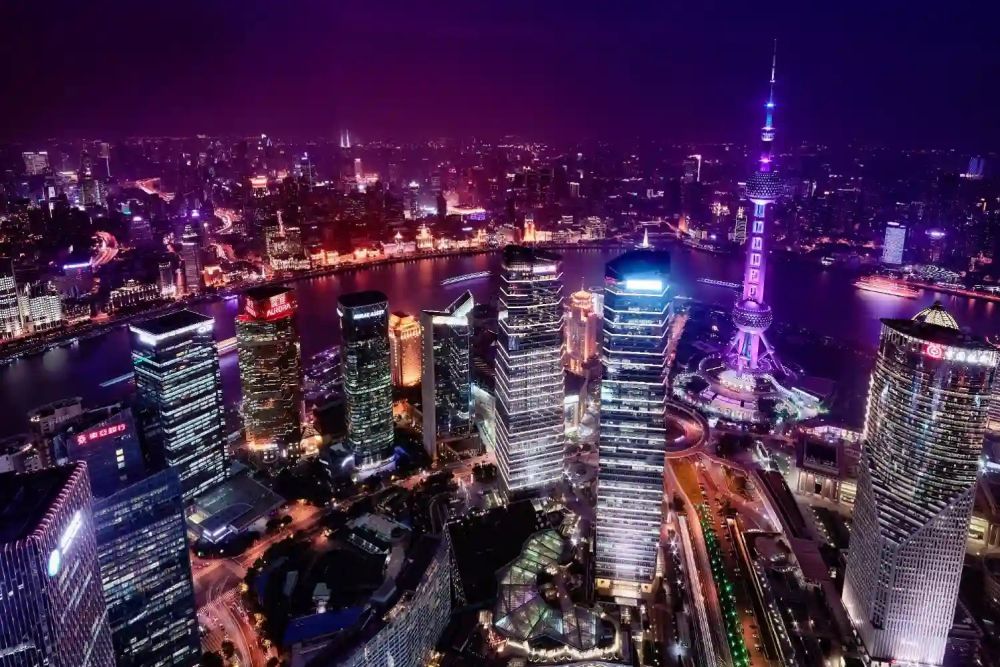
In the early 1990s, the Central Committee of the Communist Party of China and the State Council announced the development and opening-up of Pudong, which marked a turning point in Shanghai’s urban development. Pudong became a hub for international investment and a showcase and symbol of China’s reform and opening-up. By 2000, Shanghai’s GDP was 15 times that of 1990, with an average annual growth rate of 20%. The sentiments of Shanghai residents, who had long preferred a bed in Puxi to a room in Pudong, began to change. Shanghai was reborn from the ashes and entered a fast track of development. Many pioneering “firsts” were born in Shanghai, including the first stock exchange in New China, the first shares, and the first leased plot of land. Shanghai adheres to an organic unity of “pioneering, resilient, and operational” to drive innovation, transformative development, continuous adjustment and upgrading of its industrial structure, and rapid development of the financial sector. In terms of urban development, the renovation of the old city has accelerated, and historical areas have been established for comprehensive protection. Urban infrastructure has significantly improved, transforming the rusty industrial belt into a vibrant living and entrepreneurial hub. The city’s landscape has undergone a dramatic transformation. Low-rise garden houses and glass skyscrapers create a striking contrast. Since 2018, the approach to urban renewal has shifted from “demolition and renewal with demolition as the main approach” to “preservation and demolition with preservation as the main approach.”
Following the evolution of infrastructure in the city, Shanghai’s strategic urban development goals evolved and matured. In 1992, the 14th National Congress of the Communist Party of China clearly articulated the goal of transforming Shanghai into an international economic, financial, and trade center, later adding the new goal of becoming an international shipping center. In 2014, the central government assigned Shanghai the new mission of building an international scientific and technological innovation center, thus officially forming the “Five Centers” plan. In 2001, the State Council approved the construction of the Yangshan Deep-Water Port, which opened in 2005. The completion of the Yangshan Deep-Water Port revolutionized the global shipping landscape, and the Port of Shanghai maintained the highest container throughput in the world for over ten consecutive years. Thanks to the Shanghai World Expo 2010 and the simultaneous development of “three ports” (port, airport, and information center), “three networks” (rail transport, highway, and inland waterway networks), and “two roads” (expressways and high-speed railways), the city’s development has undergone rapid transformations. Rail transport, which started from scratch, has now become the longest route in the world.
In 2008, the global financial crisis hit Shanghai, ending its 16-year trend of double-digit GDP growth. However, still seeking change amidst difficulties, it pioneered a move towards innovation-driven and transformative development. In 2013, the China (Shanghai) Pilot Free Trade Zone was officially launched, and after the establishment of special economic zones, development zones, and industrial parks, this city was considered an important platform for reforms and innovation in the country. Currently, 21 pilot free trade zones and the Hainan Free Trade Port have been established across the country, forming a pilot network that covers the eastern, western, southern, northern, and central regions, injecting positive energy into China’s high-quality economic development and the global economy. Shanghai has continuously developed high-quality trade, strengthened its commercial hub function, increased its global market share, and become the world’s largest commercial port city. To the extent that in 2021, the trade volume of Shanghai Port reached 10.1 trillion yuan, increasing its global share to approximately 3.6%, and its total import and export volume exceeded 4 trillion yuan for the first time. The China International Import Expo, a national platform for promoting high-level opening-up, has been successfully hosted by Shanghai for consecutive years.
Today, Shanghai is gradually rising and asserting itself as a thriving global city. While Shanghai shares common characteristics with other global cities, it is by no means an imitation of them; instead, it possesses its own distinct features. These characteristics have been shaped by China’s national conditions, historical and cultural traditions, and its own development process. If we were to summarize the secrets of Shanghai’s urban development over the past 180 years, perhaps they could be encapsulated as: “openness, innovation, and inclusiveness.” It appears that building an international socialist metropolis with global influence and creating a people’s city with everyone’s participation are among the city’s strengths. The city is powerfully moving towards its stated goals, and there are compelling reasons to believe that the world will witness more miracles from Shanghai in the future.