
Introduction
Given the importance of familiarizing oneself with the structure and role of the Shanghai Municipality in developing relations and trade with the People’s Republic of China, this report has been prepared in three main sections. The first section introduces the structure of the municipality, its duties, departments, and how it relates to the Communist Party and the city committee. The second section presents statistics and economic and commercial information on leading companies based in Shanghai to illustrate the city’s overall economic situation. The third section, which is the shortest section of the report, criticizes the usual practice of Iranian officials by mentioning the meetings and sessions of the mayor and the secretary of the party committee in Shanghai and suggests meetings with the heads of state. While maintaining structural order, an effort has been made to present the data in a flexible manner so that the audience can obtain practical and useful information.
Part One
Shanghai is the largest city in China in terms of population and GDP, and due to its economic and strategic importance, it is governed as an independent municipality with a status equal to that of a province in the country. This special structure makes Shanghai, along with Beijing, Tianjin, and Chongqing, one of the four autonomous metropolitan areas directly under the Chinese central government, with broad powers in urban planning, economic management, social service provision, and international relations.
Shanghai Municipality is responsible for implementing major development policies based on the guidance of the Communist Party of China and strives to promote urban transformation, infrastructure development, and quality of life through precise policy-making and efficient management. In close coordination with the central government and using its own resources and powers, this municipality not only deals with urban economic and social development, but also has emerged as an important reference in national and international policies. On the other hand, Shanghai is also considered one of the most advanced examples of urban management in the world in terms of structure, which pursues sustainable growth and comprehensive development by applying new technologies and smart urban models. These conditions have made Shanghai one of the most important economic, political, and cultural hubs in the world and have established its key role in the global network of cities.
In this section, you will learn about the duties and powers of the Shanghai Municipality and its cooperation with the Communist Party of China.
The importance of this municipality in China’s power and governance structure will be examined, and at the end, key figures and important urban areas will be introduced to clarify Shanghai’s position at the national and international levels.
Duties and powers of Shanghai Municipality
Implementing the policies of the Party and the central government
As the executive arm of the Communist Party of China and the central government, the Shanghai Municipal Government is responsible for implementing the major policies and decisions of the Central Committee of the Party and the government in a comprehensive and accurate manner at the city level. In addition to adapting major plans to local conditions, it also plays an important role in managing the city’s international relations, thereby implementing the policies of the whole country in a coordinated and effective manner in Shanghai.
Urban planning and development
Urban planning in Shanghai includes the design and implementation of sustainable urban development programs, the regeneration of dilapidated areas, the development of public transportation, and the management of key infrastructure. These tasks extend beyond the city limits, and the municipality’s sphere of influence also includes more than 86 rural districts and 84 villages, which indicates its extensive and effective management. According to official sources, planning in Shanghai is based on the principles of sustainable development and attention to social justice, optimal use of resources, and environmental protection.
Economic development and investment attraction
One of the main missions of the municipality is to guide the city’s economic growth and facilitate the necessary conditions for attracting domestic and foreign investment. The Shanghai Free Trade Zone (SFTZ), established in 2013, is recognized as a leading platform in the fields of finance, high-tech and port logistics. The historic Wagaoqiao Free Trade Zone has also remained a major hub for attracting foreign investment and developing exports in China since 1990. By enacting special customs and tax regulations, developing modern infrastructure and providing integrated administrative services, the municipality has transformed these zones into competitive, safe and attractive environments for investors.
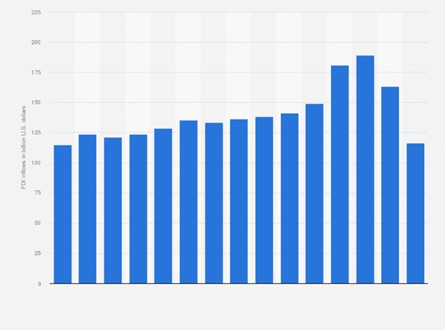
Chart 1: Annual Foreign Direct Investment (FDI) Flows into China from 2010 to 2024 (in billion US dollars)
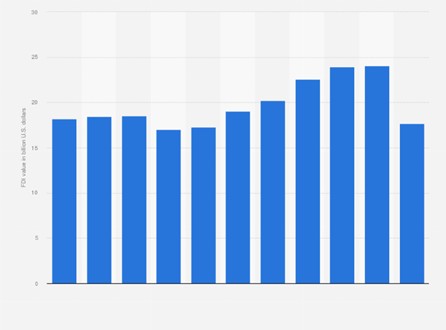
Chart 2: Value of actual foreign direct investment (FDI) deployed in Shanghai, China from 2014 to 2024 (in billion US dollars)
Based on the two charts above, it can be concluded that between 2010 and 2022, China’s total foreign direct investment (FDI) increased from about $115 billion to more than $180 billion, and then returned to about $115 billion by 2024. The real value of FDI used in Shanghai, China’s most important center for attracting foreign capital, rose from about $18 billion in 2014 to a peak of $24 billion in 2019 to 2021, and then decreased to about $18 billion by 2024. During the peak period, Shanghai accounted for about 13 to 14 percent of China’s total FDI, and in the years of declining investment (2023 and 2024), despite the total investment falling to $115 billion, Shanghai’s share increased to about 15.5 to 16 percent, which has partially compensated for the decline in the country as a whole. This shows that Shanghai plays a key and stabilizing role in attracting and utilizing foreign capital and has maintained its strategic position even during periods of economic volatility.
Public and welfare services management
The municipality is responsible for planning and providing services in the areas of housing, health, education and environmental protection. A notable example of its actions is the relocation of more than 12,600 rural households in 2019 in the form of new housing projects, which demonstrates the municipality’s efforts to improve the quality of life and residential space. In addition, policies such as the creation of a “green belt” and the reduction of the use of fertilizers and pesticides in urban areas demonstrate the municipality’s commitment to maintaining public health and a sustainable environment.
Promoting public participation and local governance
With the aim of strengthening local governance and increasing civil society participation, the municipality has organized local structures into 18 districts. Each district is divided into sub-districts and managed by residents’ committees, which play an effective role in implementing policies, providing services, and collecting public feedback. The effectiveness of these structures has been particularly evident in crises such as the COVID-19 pandemic, where these committees have played a key role in distributing essential items, monitoring patients, and enforcing quarantine regulations, and are a prominent example of the authority and efficiency of local governance in Shanghai.
The municipality’s relationship with the Chinese Communist Party
Dual party-state structure
The relationship between the Shanghai Municipality and the Communist Party of China is based on a dual party-state structure, meaning that government institutions operate alongside the government, under the supervision and guidance of the Party. In China, this structure is quite well-established and real, and Shanghai is no exception. Specifically, Communist Party organizations are present at various levels of government and transmit Party policies and guidelines to government organs, forming a “dual bureaucracy,” with Party organizations operating parallel to government institutions and playing a key role in managing bureaucratic affairs.
The role of the city party committee
At the top of Shanghai’s political structure is the Municipal Communist Party Committee, whose secretary is considered the city’s highest political authority. This committee is responsible for setting political and strategic priorities and overseeing major appointments, including the election of the mayor. Although there is a municipal government, real power lies with the Party Committee, and the mayor and cabinet are responsible for implementing the Party’s policies and decisions. For example, the “Urban Green Belt” project in 2020 and the “High-tech Zone Development” project in 2021 were both implemented under the direct leadership of the Party Committee Secretary and the mayor. In both projects, key decisions and policy-making were made by the Party Committee, and the municipal government was merely the implementer of these policies. Party representatives in the People’s Council and the Political Consultative Conference also played a key role in guiding and overseeing the progress of these projects. This structure shows that in Shanghai, real political power lies with the Party Committee, and the municipal government acts as the implementer of Party policies.
Party presence at low levels
The party also has an active presence at lower levels by forming party branches in offices, neighborhoods, and organizations. In each street-level office, there is a party committee, known as the “fortresses of struggle” and “red flags,” because they can mobilize and guide society and the bureaucracy in political campaigns. This structure has enabled party policies to be implemented directly in people’s daily lives and has strengthened government accountability at the local level.
Selection and appointment mechanism
In the process of electing the mayor and senior officials, the Shanghai People’s Congress plays a formal role, but candidates are actually selected by the Party Committee and approved by the Party Central Committee. The mayor of Shanghai is elected by the Party’s decision, and the Party Committee Secretary has more power and influence than the mayor. Therefore, complete loyalty to the Party and strict adherence to its policies are the main prerequisites for obtaining key positions in the municipality.
Shanghai as a “cadre training school”
Shanghai is known as the Communist Party’s “cadre training school,” and many prominent leaders have gained managerial and political experience in the city before rising to senior national positions. The city has been a launching pad for leaders such as Jiang Zemin, Zhou Rongji, and Xi Jinping, who all held senior positions in Shanghai before taking on national leadership. This background has allowed them to have strong managerial skills and practical experience in running a large and complex city.
The position of the municipality in the system and structure of China
An administrative unit at the provincial level
Shanghai is one of four cities in China that is recognized as a prefecture-level city. In China’s administrative structure, there are five levels of division: national, provincial (provinces, autonomous regions, and directly administered cities), prefectural, county, and rural. Although Shanghai is comparable in size and population to many small provinces, it is directly under the central government due to its economic and strategic importance. This special status allows the municipality to formulate and implement specific economic regulations and policies with the approval of the central government; for example, in 2021, the Standing Committee of the National People’s Congress authorized the Shanghai People’s Congress to formulate special regulations for the Pudong District (Pudong New Area) based on the needs of reform and innovation. This expands Shanghai’s local legislative powers and allows the city to enact regulations that suit its local characteristics, as long as they do not conflict with the national constitution.
Relations with the central government and the Party Central Committee
Shanghai Municipality must fully coordinate with the central government and the State Council in formulating development plans, budgets, and local regulations. The central government sets macro-economic and social goals, and the municipality plays an executive role in achieving these goals. In recent years, the Chinese central government has turned Shanghai into a pilot economic reform by delegating some legislative and policy implementation powers to the city. The Lingang Special Zone, a subsidiary of the Shanghai Free Trade Zone, is a prominent example of this approach. In this zone, 87 system innovations have been implemented, including business facilitation mechanisms and redefining management frameworks. For example, the launch of the first international coastal shipping line in Lingang testifies to the development of logistics infrastructure and the region’s connection to global markets. Also, the attraction of the first foreign joint venture under foreign management in the field of wealth assets indicates the facilitation of international partnerships and the enhancement of the region’s autonomy within the framework of national macro-policies. These developments are a concrete example of the interaction between central policies and local requirements to achieve sustainable growth and innovative development.
Representation in national institutions
Shanghai has numerous representatives in the National People’s Congress (NPC) and the Chinese People’s Political Consultative Conference (CPPCC), who defend the interests of the city and its population and participate in the formulation of national laws and policies. In addition, consultative bodies such as the CPPCC also operate at the city level, reflecting the views and expertise of various groups in society. The active presence of Shanghai representatives in the national arena ensures that policies are as closely aligned as possible with the needs and realities on the ground in this metropolis, and provides more opportunities for local reforms.
Internal structure of the municipality and committees
Multi-layered administrative structure
Shanghai’s municipal government is structured according to China’s complex, multi-layered bureaucratic model, with various departments, each with a wide range of specialized tasks. At the top of this structure is the Municipal Bureau, or “General Office,” which coordinates day-to-day affairs, drafts documents, and oversees the implementation of government decisions.
The Development and Reform Commission[1] is a key department responsible for formulating economic and social development plans, implementing reform policies, and managing major infrastructure projects. Alongside it, the Economic and Information Technology Commission[2] has a special focus on industrial policy-making, promoting innovation in high-tech industries, and supporting small and medium-sized businesses.
The Commerce Commission[3] is responsible for managing domestic and foreign trade, supervising wholesale markets, and cooperating with relevant ministries to attract foreign investment. In addition, the Education, Science and Technology, Ethnic and Religious Affairs, Public Security (Police), Civil Affairs, Culture and Tourism, and Health Commissions all have their own specialized areas of responsibility. Although it is not possible to provide a comprehensive list of institutions due to limited access to complete information, based on the experience of the administrative structure of other Chinese provinces, Shanghai Municipality has about 50 to 60 specialized departments and commissions under the supervision of the mayor and his deputies, which operate in a coordinated manner.
Geographical divisions: regions and subdivisions
Shanghai’s political-administrative structure is also highly organized geographically. The city is divided into 16 districts, each with its own regional government, people’s congress, and party committee, responsible for implementing policies within its boundaries. Each district is in turn divided into subdivisions such as sub-districts and rural towns.
At the lowest level, residents’ committees and village committees are established, which play a vital role in implementing urban programs and communicating with the people. This four-tier structure (government-district-subdistrict-committee) ensures that the municipal macro-policies are implemented effectively and accurately down to the neighborhood and smaller city sections.
The role of specialized commissions and affiliated organizations
In addition to administrative departments, Shanghai Municipality has affiliated government companies and institutions responsible for implementing major projects and providing public services. The Shanghai State Investment Commission and its subsidiaries manage public assets and invest in areas such as urban development and infrastructure.
Research has shown that the municipality manages important development projects through these investment companies and uses government bonds to finance them in addition to land sales. Such a mechanism allows the municipality to invest in large projects with high flexibility and to advance urban development at the desired speed and quality.
City Council and the Supervisory Role
As the local legislative body, the Shanghai People’s Congress is responsible for enacting local laws and regulations and overseeing the performance of the city government. The congress is composed of elected representatives from various regions and has several specialized committees that work in specific fields.
In addition, the Shanghai People’s Political Consultative Conference (CPPCC), as the city’s advisory body, plays an important role in gathering expert opinions and representing various social groups, non-affiliated parties, minorities, and non-governmental organizations. This advisory body brings more expert depth and broader perspectives to decision-making, and helps the interaction between the government and civil society in Shanghai.
Influential people in the economic and international fields
Secretary of the Shanghai Municipal Party Committee: Chen Jining
Chen Jining has been the Secretary of the Shanghai Party Committee, the city’s highest political office, since January 2023. In a meeting with the Australian Prime Minister in July 2025, he was recognized as the Secretary of the Party Committee, indicating his continued presence in this position.[4] Chen has a strong academic background in environmental engineering and was previously Minister of Environment and President of Tsinghua University. He has a particular focus on sustainable development, digital transformation, and scientific innovation, and he pursues these views in the city’s governance.
Mayor: Gong Zheng
Gong Zheng has been the mayor of Shanghai since March 2020 and is still in office. The OPCW report mentions a meeting with the organization’s director general in June 2025. Before becoming mayor of Shanghai, Gong was governor of Shandong Province and chairman of the China Tourism Organization, and held various executive and management positions in the areas of economic development, infrastructure, environmental policy, and crisis management. His role in guiding the metropolis has been crucial, with major projects under his watch.
Deputy mayors and economic figures;
In Shanghai Municipality, each deputy mayor is usually responsible for several commissions or departments related to his or her area of expertise to ensure better coordination in city management. This multi-layered structure helps make decision-making and policy implementation more comprehensive and effective.
According to official information from the Shanghai Municipality, the current deputy mayors of the city are:
⦁ Hua Yuan: Responsible for foreign investment and international cooperation, managing several departments related to economic development and attracting foreign investment.
⦁ Zhang Xiaohong: Responsible for economic development and leading industries, leading the city’s economic and industrial commissions.
⦁ Liu Duo: Responsible for Environment and Sustainable Development, managing departments related to environmental protection and urban green programs.
⦁ Xie Dong: Works in the field of public services and urban policies and oversees several urban service departments.
⦁ Zhang Yahong: Responsible for transportation and urban infrastructure development, covering the Transportation Commission and related infrastructure departments.
⦁ Chen Jie and Chen Yujian: Responsible for executive management, urban services and public policies, coordinating numerous commissions and departments in these areas.
These vice-chairmen are simultaneously responsible for several commissions or departments in areas such as innovation, economy, environment, transportation and public services to form an integrated and comprehensive approach to Shanghai’s growth and development. With expertise in engineering, economics and large-scale project management, the team of vice-chairmen plays an important role in promoting sustainable development and increasing the efficiency of urban management.
National figures who emerged from Shanghai
Shanghai has always been the launching pad for great national leaders in China. For example, Jiang Zemin, who was general secretary of the Communist Party of China from 1989 to 2002, served as mayor and party secretary of Shanghai before coming to national power, gaining experience in managing this complex metropolis. Former Chinese Premier Zhou Rongji was mayor and party secretary of Shanghai in the 1990s, and used this experience to implement national economic reform policies and push forward economic reform.
Xi Jinping, China’s current leader, was also the party secretary of Shanghai for a few months in 2007, before being promoted to the Standing Committee of the Communist Party’s Politburo and eventually elected as the party’s general secretary. Political insiders believe that the management experience in Shanghai has provided these figures with the opportunity to practice policy-making and macro-leadership skills.
Shanghai, which has become known in recent decades as the Chinese Communist Party’s “cadre training school,” is a place where leaders acquire the skills needed to run the country. This reputation stems from the complexities of managing a huge, densely populated city, with its vast economic, social, and cultural challenges, which prepare them for work at the highest levels of government.
These leaders’ experiences in Shanghai have taken place in the context of the city’s turbulent history, from Deng Xiaoping’s economic reforms to the crisis management and decentralization pursued by local and national politicians. Shanghai became the engine of China’s economic growth in the 1990s, and local leaders played a key role in this process.
Industrial zones, technology parks and free trade zones
Shanghai Free Trade Zone (SFTZ)
The Shanghai Free Trade Zone was launched in September 2013 and initially included the Wagaoqiao area, Yangshan Port, and Pudong Airport. The zone was established to test major economic reforms such as reducing customs barriers, facilitating trade, and liberalizing foreign exchange. The zone is the first of its kind in China, providing a more open environment for foreign companies to operate, with a special focus on areas such as financial services, port logistics, and high-tech industries. Such an environment allows companies to access the Chinese domestic market with less bureaucracy and better facilities, and to benefit from the economic benefits of the region.
Lingang Special Zone
Lingang was established in 2019 as a key part of the Shanghai Free Trade Zone. In the first three years of its establishment, more than 64,000 companies were registered in the zone, of which more than 2,600 foreign companies started operating. By providing tax incentives and special regulations, Lingang has become a center for attracting domestic and foreign investment in fields such as high-tech, intelligent transportation and new energy. For example, Danish company Maersk carried out the first international coastal cargo transportation through the zone, and French company Amundi launched the first foreign controlling investment in wealth management here. These successes demonstrate the high importance of Lingang in attracting international technology and investment.
Zhangjiang Hi-Tech Park
Zhangjiang Science and Technology Park in Shanghai’s Pudong district is known as a major hub for scientific innovation and R&D. The park is home to R&D centers of major multinational companies such as AstraZeneca, JSK, Novartis, Roche, Pfizer, DuPont, and GE, and employs more than 300 life science companies and about 20,000 researchers. This focus has led foreign managers and investors to consider Shanghai as an important and pivotal center for global R&D.
The main goal of the Zhangjiang Park is to promote technological innovation, industrial growth, strengthen talent education and training, and environmentally sustainable development. A program called “Focus on Zhangjiang,” launched by the municipal government in 1999, is dedicated to the development of electronic chip, software, and biopharmaceutical industries. The park is home to ShanghaiTech University, advanced research institutes, and start-ups alongside large industries. The use of green technologies such as solar panels and electric vehicle infrastructure reflects the region’s focus on environmental sustainability.
Other industrial and technological areas
In addition to Zhangjiang Park and Lingang District, Shanghai has a wide range of industrial and technological zones, each of which plays an important role in the city’s economy and technological development; these zones include:
⦁ Jinqiao Export Processing Zone, which focuses on the production of electronic goods, medical equipment, and automobiles.
⦁ Caohejing Innovation Park, which hosts information technology, communications, and software startups.
⦁ Lujiazui Financial District, which is known as a center for financial services, banking, and insurance, and is home to the Shanghai Stock Exchange and leading global investment companies.
⦁ Waigaoqiao Bonded Area, which is a leader in the import trade of consumer goods, automobiles, and luxury goods.
By providing advanced infrastructure, tax exemptions, and online administrative services, these industrial and technology zones have created a favorable environment for attracting foreign investment and economic growth, and play an important role in advancing Shanghai’s development goals.
Digital environment and governance innovation
Shanghai has been moving at a remarkable pace in the past decade, with significant improvements in government services, improved transparency, and increased public participation. The One Netcom Office project is a prime example of this change, which leverages advanced technologies such as artificial intelligence, big data, and blockchain to provide hundreds of government services to more than 73 million real users and millions of businesses in a centralized, online manner. By integrating data and processes from different departments, it has reduced response times to minutes. As a practical and tangible example, Shanghai Huawei Bank has been able to register mortgages completely online without having to visit in person, which is an important step in reducing bureaucracy and facilitating financial affairs.
At the same time, the City Brain project, by connecting more than 900 digital services and utilizing real-time environmental and traffic data, has enabled intelligent traffic management, rapid response to emergencies such as the COVID-19 pandemic, optimization of public services, and improvement of quality of life; by intelligently adjusting traffic lights, predicting high-traffic areas, and prioritizing emergency vehicles, this system has reduced travel times, increased traffic speeds, and improved urban safety. At the same time, these technologies have raised concerns about privacy and the possibility of centralized surveillance, and real public participation in digital urban decision-making is still limited.
In terms of infrastructure, Shanghai plays a key role in China’s communications ecosystem; China Netcom, which has been building the city’s critical technology infrastructure by deploying fiber optic networks since 2003, is one of the largest communications players. The Lingang Special Economic Zone has also promoted Shanghai’s position as a data and technology hub in East Asia with plans to attract foreign investment in telecommunications value-added services and the establishment of a cross-border data flow service center. In addition, new plans that have been implemented since 2024 have allowed full foreign ownership of data centers and value-added services in Shanghai, paving the way for investment and development of new technologies such as artificial intelligence and cloud computing.
These developments are part of the Chinese government’s broad digital governance policies, which focus on social governance, political stability, and data security in addition to improving services. Investing billions of yuan in the development of e-government and smart cities, Shanghai is recognized as a leading hub in digital transformation, striving to provide seamless, transparent, and secure services. Initiatives to promote digital commerce and advanced computing infrastructure, such as the National Internet Center and a target to build five new data centers by 2025, confirm this growing trend. However, the path to completing this transformation is fraught with technical, security, and social challenges, including protecting privacy and ensuring genuine public participation, which require careful management.
Challenges and solutions for Shanghai’s urban management
Bureaucratic challenges and party-government coordination
One of the biggest challenges for Shanghai’s municipality is the coordination between the dual structure of the party and the state. The dual bureaucracy can complicate and slow down the decision-making process, as the party and state organizations must operate in parallel and in coordination. Also, the party’s political priorities can sometimes conflict with local economic needs or social demands, making city management difficult.
The average monthly air quality index for Shanghai from January 2022 to August 2025 shows that air quality tends to worsen in the colder months of the year (January to March and autumn), with the AQI reaching around 70 to 85. In contrast, air quality tends to improve in the spring and summer months, with the index typically ranging between 45 and 65, although there are also brief peaks. These seasonal fluctuations and the lack of a consistent downward trend indicate ongoing challenges in air pollution control and the need for more sustainable solutions to improve Shanghai’s air quality.
Demographic and environmental pressures
With a population of about 25 million, Shanghai faces problems such as heavy traffic, air pollution and a shortage of housing. The municipality is looking for solutions such as expanding subway lines, increasing green space, restricting polluting vehicles and implementing urban renewal projects, some of which have been successfully implemented in recent years. There are also plans to gradually phase out fossil fuels, increase the use of electric vehicles and improve air quality, but rapid economic growth and the increase in the number of private cars continue to put great pressure on the environment.
Competition with other regions
Shanghai is in close competition with more dynamic cities like Shenzhen and Guangzhou, all of which are trying to attract a greater share of the world’s capital and innovative talent through tax incentives, free zones, and technology parks. Therefore, the municipality needs to improve its business environment, create a more cost-effective administrative environment, and develop clear and attractive regulations to attract foreign companies.
Geopolitical developments and international trade
Trade tensions between China and Western countries have had an impact on Shanghai’s exports, foreign investment, and technological cooperation. Policies such as export controls on sensitive technologies and sanctions on Chinese companies may limit the growth of some industries in the city. In response, China is seeking to develop its domestic market, strengthen cooperation with Asian and European countries, and expand the Belt and Road Initiative. As China’s financial and trade hub, Shanghai must be able to balance these complex conditions and explore new opportunities for international cooperation.
Top Companies in Shanghai
A detailed understanding of Chinese companies, especially those based in Shanghai, is of vital importance in the development of economic relations and mutual benefit. With their key position in the Chinese economy and global markets, these companies create vast opportunities for cooperation, technology transfer, and joint ventures that can greatly contribute to the process of sustainable development and increase the competitiveness of the economies of countries like Iran. Analyzing the structure and performance of these companies allows policymakers and economic actors to design efficient strategies for economic convergence and strengthening trade interactions, and to pave the way for mutual growth.
The 2025 Fortune Global 500 list provides a broad overview of the world’s largest companies, with combined revenues of about $41.7 trillion, more than a third of global GDP, up 1.8 percent from the previous year. The financial sector is the most populous with 121 companies, followed by energy, motor vehicles, technology and healthcare. Companies such as Walmart, Amazon and, among the Chinese, State Grid, China National Petroleum and Sinopec are among the top performers on the list. Their combined net profit also rose 0.4 percent to $2.98 trillion. Of course, the average profit of Chinese companies has fallen, but the 7.4 percent growth in profitability performance indicates a move towards improving quality and efficiency.
Among Chinese companies, 12 Shanghai-based companies play a key and influential role. They operate in a variety of fields, including steel, automobiles, banking, transportation, insurance, construction, pharmaceuticals, and real estate development, and their revenues range from $33.5 billion to $125 billion. Notably, companies such as PDD Holdings (e-commerce), Bank of Communications of China, and COSCO Shipping (shipping) are in a favorable position in terms of profitability and revenue growth, while companies active in the real estate and construction sectors have faced challenges such as declining revenue and losses.
Analysis of the performance of these companies shows that Shanghai, as the financial and industrial center of China, is the driving force of the national and regional economy and has an important share in global markets. Compared to global averages, the revenue and profit of these companies are still lower than their American counterparts, but the growing and positive trend of profitability is a sign of efforts to increase productivity and competitiveness at the global level. These successful experiences and models can be valuable models for developing economies such as Iran, especially in the fields of banking, technology, e-commerce, transportation and construction management. In the following, detailed information on revenue, profit, and detailed analysis of these 12 Shanghai companies as well as their Middle Eastern partners are presented, which can provide complete insight for economic studies and strategic decision-making.
Rank in Shanghai |
Company name |
English |
Field of activity |
World ranking |
درآمد به میلیارد دلار |
Change in income |
سود به میلیارد دلار |
1 |
China Bao Steel Group |
China Baowu Steel Group |
Steel and metal industries |
73 |
125.1 |
-۲۰.۴٪ |
۲.۴۹۷ |
2 |
SAIC Automotive Company |
SAIC Motor |
Automotive and transportation |
138 |
87.2 |
-۱۷.۱٪ |
$231.6 million |
3 |
Bank of Communications of China |
Bank of Communications |
Banking and Finance |
168 |
75.8 |
-۳.۷٪ |
۱۳.۰۰۶ |
4 |
COSCO SHIPPING COMPANY |
COSCO Shipping |
Maritime transport and logistics |
212 |
64.9 |
+۲۰.۳٪ |
۵.۸۶۶ |
5 |
China Pacific Insurance Group |
China Pacific Insurance (Group) |
Insurance and financial services |
251 |
56.2 |
+۲۲.۷٪ |
۶.۲۴۸ |
6 |
PDD Holdings |
PDD Holdings |
E-commerce and technology |
266 |
54.7 |
+۵۶.۵٪ |
۱۵.۶۲۶ |
7 |
Shanghai Pudong Development Bank |
Shanghai Pudong Development Bank |
Banking and Finance |
309 |
48.9 |
-۳.۸٪ |
۶.۲۸۹ |
8 |
Susan Development Group |
Susun Construction Group |
Construction and engineering |
338 |
45 |
-۰.۶٪ |
۹۲۴.۲ میلیون دلار |
9 |
Shanghai Construction Group |
Shanghai Construction Group |
Construction and engineering |
374 |
41.7 |
-۳٪ |
$301.3 million |
10 |
Shanghai Pharmaceutical Holdings |
Shanghai Pharmaceutical Holding |
Pharmacy and Health |
407 |
38.3 |
+۴٪ |
$632.7 million |
11 |
Shanghai Delong Steel Group |
Shanghai Delong Steel Group |
Steel and metal industries |
467 |
34.5 |
+۰.۳٪ |
$207.1 million |
12 |
Greenland Holding Group |
Greenland Holding Group |
Real estate development |
480 |
33.5 |
-۳۴.۲٪ |
-2.161 (loss) |
Table 1: Top 12 Shanghai Companies in Fortune Global 500
A financial review of the top 12 Shanghai companies on the Fortune Global 500 likely illustrates how trends in profitability, revenue growth, and loss-making across different economic sectors may create opportunities and challenges for economic development.
Meanwhile, PDD Holding Group, with the highest net profit ($15.626 billion) and impressive revenue growth (+56.5%), is likely a symbol of success in the field of e-commerce and technology. This success seems to show that by taking advantage of innovation, technology, and new business models, a strong competitive position can be quickly created. This has a clear message for Iran, which is developing its technology infrastructure and digital economy: supporting startups, developing IT infrastructure, and creating a dynamic business environment is likely to accelerate the path of economic progress.
Banking and the financial system, which are the backbone of the economy, play a key role; Bank of Communications of China, with significant profits but negative revenue growth, seems to be a reminder of the challenges of digital transformation and the need to increase efficiency in this sector. Given the importance of financing for various industries and start-ups, Iran is likely to need structural reforms, technological modernization, and strengthening of financial institutions to form effective and sustainable investments.
In the areas of transportation, logistics and steel, companies such as Cosco Shipping, which have seen significant revenue growth (+20.3%), can demonstrate the importance of these sectors in developing infrastructure and supporting national production. For Iran, which faces sanctions and barriers to access to global markets, strengthening these chains and creating self-sufficiency is likely to be of vital importance and could lead to job creation and increased competitiveness.
On the other hand, the real estate sector, with Greenland Holding Group’s significant losses, probably represents the potential risks of investing without risk management and economic developments. The real estate market in Iran has also always been affected by price fluctuations and changing financial policies, and the experience of similar companies in China can be useful in formulating risk management strategies and long-term planning for the sustainable development of the housing and urban development sector.
Overall, this study suggests that the simultaneous combination of technology and innovation, a modern financial system, the development of transportation and logistics infrastructure, and careful management of the real estate industry are likely to be the keys to economic success in the current period. This combination can provide a framework for Iranian decision-makers and economic planners to use international experiences to achieve sustainable and inclusive growth. To help complete the information and accelerate the analysis process of the respected reader, some of the collaborations and joint projects of these companies with partners from the Middle East are mentioned below.
Projects of top Shanghai companies in the Middle East
- شرکت مستقر در شانگهای:
China Baowu Steel Group
شریک یا محل همکاری در خاورمیانه:
شرکت نفت سعودی آرامکو و صندوق سرمایهگذاری عمومی عربستان (PIF)
پروژه مشترک و ارقام رسانهای:
In 2024, a joint venture was set up to produce a heavy plate steel plant in the Saudi Arabian city of Ras al-Khair, doubling the investment. Baosteel owns 50% of the venture, while Aramco and PIF each hold 25%. The announced investment is $1 billion, and the project’s capacity includes 2.5 million tons of sponge iron and 1.5 million tons of steel plates per year. The plant is being built within the framework of China’s Belt and Road Initiative and Saudi Arabia’s Vision 2030.
- شرکت مستقر در شانگهای:
SAIC Motor
شریک یا محل همکاری در خاورمیانه:
گروه منصور (مصر)
پروژه مشترک و ارقام رسانهای:
In December 2024, SAIC Motor and Mansour Group signed a $135 million contract to build a plant to produce MG brand cars in Egypt. The initial capacity is 50,000 units per year, with the possibility of increasing to 100,000 units; more than 45% of the parts must be sourced domestically, and production will begin in the second half of 2026.
- شرکت مستقر در شانگهای:
Bank of Communications (BOCOM)
شریک یا محل همکاری در خاورمیانه:
مرکز مالی بینالمللی دبی (DIFC)
پروژه مشترک و ارقام رسانهای:
این بانک در نوامبر ۲۰۲4 شعبهای در DIFC افتتاح کرد تا خدمات مالی و سرمایهگذاری به شرکتهای چینی و مشتریان خاورمیانه ارائه دهد. BOCOM جزو پنج بانک بزرگ چین است و داراییهای مؤسسات خارجی آن تا ژوئن ۲۰۲۴ حدود ۱٫۲۴ تریلیون یوان بوده که حدود ۸٫۸٪ از کل داراییهای بانک را تشکیل میدهد.
- شرکت مستقر در شانگهای:
COSCO Shipping
شریک یا محل همکاری در خاورمیانه:
(بندر جده، عربستان)، صندوق سرمایهگذاری عمومی عربستان، شرکت بنادر ابوظبی
پروژه مشترک و ارقام رسانهای:
شرکت تابعه COSCO Shipping Ports در سال ۲۰۲۱ بیست درصد از سهام پایانه «Red Sea Gateway Terminal» در بندر جده را به ارزش ۱۴۰ میلیون دلار خرید و صندوق سرمایهگذاری عمومی عربستان نیز با پرداخت مبلغ مشابه مالک ۲۰٪ دیگر شد. قرارداد بلندمدت این پایانه سرمایهگذاری ۱٫۷ میلیارد دلاری تا سال ۲۰۵۰ برای اتوماسیون و توسعه ظرفیت ۹ میلیون TEU را پیشبینی میکند. در امارات نیز پایانه نیمهاتوماتیک CSP Abu Dhabi Terminal که حاصل مشارکت COSCO و بنادر ابوظبی است، با سرمایهگذاری ۱٫۱ میلیارد درهم (حدود ۲۹۹ میلیون دلار) توسط COSCO ساخته شد و ظرفیت طراحی ۲٫۵ میلیون TEU دارد.
- شرکت مستقر در شانگهای:
China Pacific Insurance (CPIC)
شریک یا محل همکاری در خاورمیانه:
اداره سرمایهگذاری ابوظبی (ADIA)؛ شرکت بیمه «مدگلف» عربستان
پروژه مشترک و ارقام رسانهای:
In 2013, ADIA bought about 2.75% of CPIC’s shares for $160 million, increasing the company’s capitalization to $1.3 billion. Also in February 2025, Saudi insurer Medgulf signed agreements with three major Chinese companies, including China Pacific Insurance, to develop new insurance products for the Saudi market and the 2030 vision by transferring Chinese technology and experience; the investment amount was not disclosed.
- Shanghai-based company:
PDD Holdings (Temu)
شریک یا محل همکاری در خاورمیانه:
شرکت لجستیک EMX (امارات)، گروه DHL
پروژه مشترک و ارقام رسانهای:
In January 2025, Temu signed a strategic partnership with EMX (the logistics arm of 7X). Under the agreement, Temu’s ocean freight capabilities and “package delivery and pickup” (PUDO) services will be expanded to reduce costs and increase flexibility in the UAE and other Gulf countries. Temu launched in the UAE in September 2023 and is now also active in Saudi Arabia, Kuwait, Qatar, Bahrain, Oman and Jordan. In April 2025, Temu and DHL also signed a memorandum of understanding under which DHL will support Temu’s multimodal services and “local-to-local” model in Europe and the Middle East; the aim of the partnership is to increase sales to small and medium-sized businesses, with an expected 80% of Temu’s sales in Europe coming from the local-to-local model.
- شرکت مستقر در شانگهای:
Shanghai Construction Group (SCG)
شریک یا محل همکاری در خاورمیانه:
کمیته عالی تحویل و میراث، جام جهانی قطر/ بنیاد قطر
پروژه مشترک و ارقام رسانهای:
SCG was one of the structural contractors for the Education City Stadium (or Qatar Foundation Stadium) for the 2022 World Cup. The company designed and manufactured 52 V-shaped steel columns in China and shipped them to Qatar for installation; the largest columns were 17 meters high and weighed 14 tons. The project was a collaboration with Qatari authorities, and the contract value was not disclosed.
- شرکت مستقر در شانگهای:
Shanghai Pharmaceutical Holding (SPH)
شریک یا محل همکاری در خاورمیانه:
SPH Middle East FZ‑LLC (امارات)
پروژه مشترک و ارقام رسانهای:
گزارش سالانه ۲۰۲۴ این شرکت اعلام کرد که طرح گسترش خارج از کشور شامل راهاندازی شرکت «SPH Middle East FZ‑LLC» در منطقه آزاد دبی است. این شرکت طی سال ۲۰۲۴ ثبت رسمی شد و فرایند ثبت داروها را آغاز کرد. SPH با تکمیل شبکه آسیای جنوب شرقی و خاورمیانه موفق به ثبت محصولات متعدد در درمانهای مختلف شده و درآمد فروش خارجی شرکت در سال ۲۰۲۴ به ۳٫۹۶۷ میلیارد یوان (رشد ۲۴٫۵۳٪) رسید.
- شرکت مستقر در شانگهای:
Shanghai Delong Steel Group
شریک یا محل همکاری در خاورمیانه:
Steelinvest (بلژیک)؛ وزارتخانههای عربستان و امارات
پروژه مشترک و ارقام رسانهای:
In February 2025, Delong Steel and Belgian company Steelinvest established a joint venture called Ziming SG Global in Dubai. The company is to handle the export of Delong’s semi-finished and finished products, with a long-term goal of achieving an annual output of five million tons of steel. Also in 2022, Chinese investors Delong Group and Tianjin TEDA Investment Holding agreed with Saudi parties to build a steel industrial park with a capacity of ten million tons per year in Saudi Arabia. In June 2024, Emirates Steel Arkan and Delong Steel Group signed a memorandum of understanding to build a low-carbon raw material production plant and reduce carbon emissions in steel production; financial details were not available.
- شرکت مستقر در شانگهای:
Greenland Holding Group
شریک یا محل همکاری در خاورمیانه:
سرمایهگذار راهبردی کویتی (Al Waseet International) و صندوقهای مستقل منطقه
پروژه مشترک و ارقام رسانهای:
شرکت تابعه Greenland Hong Kong در آوریل ۲۰۱۶ با «Kuwait Strategic Investor» توافق کرد تا یک صندوق املاک و مستغلات به ارزش ۸ میلیارد دلار ایجاد کند. این صندوق قرار است در داراییهای مسکونی و تجاری درجه یک سرمایهگذاری کند و با چند صندوق ثروت مستقل خاورمیانه همکاری عمیق داشته باشد. طبق گزارش بعدی، مرحله نخست این صندوق ۳۰۰ میلیون دلار سرمایه جذب کرد. شرکت کویتی در مقابل سهام ترجیحی قابل تبدیل دریافت کرد و Greenland ۴۱٪ از پروژه هتلی در نیویورک را به دست آورد.
In short, the main areas of China (Shanghai) economic cooperation in the Middle East include steel, automobile, banking, transportation, insurance and pharmaceutical industries. Chinese companies such as Baosteel and Delong Steel have made large investments in steel joint projects with Arab countries, including a $1 billion investment in a heavy plate steel plant in Saudi Arabia. SAIC Motor has also signed a $135 million contract in Egypt to produce MG cars. Also, in other areas, Chinese companies have launched large-scale projects in cooperation with banks and logistics companies in the Middle East, such as COSCO Shipping and China Pacific Insurance (CPIC), to expand infrastructure, financial services and technology transfer. It goes without saying that the aforementioned projects are just some of the regional partnerships of Shanghai-based companies that have become media.
Level of meetings and joint sessions
In order to understand the importance of the municipality and the Party Committee in Shanghai, this section refers to some of the meetings of high-ranking officials from other countries with the mayor and the Party Committee Secretary.
⦁ On May 14 and 15, 2023, Shanghai Mayor Gong Zheng and Shanghai Party Committee Secretary Chen Jining discussed cooperation in the fields of smart city, innovative projects, financial services, and academic cooperation with Lawrence Wong, Deputy Prime Minister and Minister for Finance of Singapore.
⦁ On August 25, 2025, Gong Zheng and Saudi Minister of Investment Khalid Al-Falih discussed investment synergies and enhanced cooperation of the Saudi-Chinese Joint Committee, and a workshop on the “China-Saudi Industrial Chain” was held.
⦁ On June 26, 2025, Party Committee Secretary Chen Jining spoke with Vietnamese Prime Minister Pham Minh Chien about urban cooperation, financial trade, green development, digital and tourism.
⦁ On June 19, 2025, Chen Jining met with New Zealand Prime Minister Christopher Lacson and discussed the development of economic and cultural relations and New Zealand’s adherence to the one-China policy.
⦁ In July 2025, an important meeting was held between Secretary of the Shanghai Party Committee Chen Jining and Australian Prime Minister Anthony Albanese. They discussed strengthening economic and trade cooperation and developing relations.
As the above cases show, contrary to the notion of the Iranian elite and agents who reduce the level of meetings to a mayor-mayor meeting and who basically do not consider the party committee in this city to be a sane place or are unable to communicate due to the lack of a counterpart in the Iranian administrative system, the following suggestions are presented that may be useful in this regard as well.
Conclusions and strategic recommendations
Shanghai’s municipal government has a complex, multi-layered structure, where most political power is vested in the Communist Party Committee and its secretary, but the municipal government is responsible for implementing decisions and day-to-day management of the city. Although this duality increases bureaucracy, it has been able to create stability and predictability in the city’s administration through close party oversight. As a laboratory for economic reform, Shanghai has provided special opportunities for foreign investment.
For economic activists and government managers, familiarity with Shanghai’s political and administrative structure is of particular importance:
⦁ They should know that major decisions are in the hands of the city party committee and their implementation depends on the government, so effective communication with both sectors is essential.
⦁ Utilizing the capacity of free trade zones, Lingang Zone, and Zhangjiang Technology Park can create a competitive advantage for businesses, and it is important to take advantage of their tax exemptions and special opportunities.
⦁ Based on the experience of other countries, joint meetings with municipal officials and the Party Committee in Shanghai seem justified even at the level of the top executive branch. Meetings held solely at the mayor level, although necessary, do not lead to mutual benefit because they stem from a reductionist perspective and are unfamiliar with the Chinese structure.
⦁ The principle in business relations with Shanghai should be a long-term view. Shanghai, as a laboratory for reform and a launching pad for party leaders, has always acted as a compass for China’s future developments. Therefore, closely monitoring the plans and performance of the Shanghai municipal government and establishing business relations with it will not lead to short-term profits.
⦁ Finally, it is suggested that for joint cooperation with companies based in Shanghai that are practically subordinate to the city government, in addition to the models mentioned in the section on top Shanghai companies and sanctions restrictions, attention should be paid to the requirements of the Iranian economy and environment.