
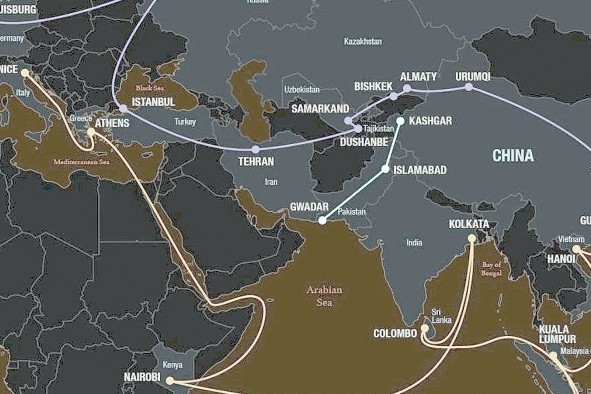
The Silk Road is considered one of the most prominent phenomena in the history of world civilization, not only as a trade route, but also as a vast network of human, economic and cultural connections. This road was known as a highway for the transport of goods, connecting the East and the West for a long distance, and various wealth and products passed through it. Meanwhile, China was more famous than anything else in the ancient world for silk. A precious and seductive commodity that gave life to the diversity of trade and was so important that the name of this road was taken from it and to this day it still reminds us of the special place of silk in the history of global exchanges. Chinese silk had a unique place in the markets of Iran, Central Asia and even in Rome and Byzantium, and sometimes its value was measured with gold and exchanged at the same price. This rare and delicate product not only adorned fine clothing and fabrics, but was also a symbol of splendor and luxury, and for this reason there was a great demand for it. In turn, Iran also sent various products to China: from metals and metal products made by the skill of Iranian craftsmen, to transparent and valuable glass, rare gemstones, and also various agricultural products. Among these goods, handmade Iranian carpets had a special place. Carpets that showcased ancient Iranian art, taste, and skill, found a special expression in palaces and courts of the East and the West, and were always a symbol of the splendor of Iranian culture.
This historical route gradually took shape from the centuries BC and reached its peak during the Achaemenid, Parthian and Sasanian periods. The Achaemenid Empire, by constructing the Royal Road, created a systematic and efficient model for commercial and military communications that later became part of the vital artery of the Silk Road. On the Iranian plateau, important cities such as Samarkand, Bukhara, Merv, Tus, Damghan, Gorgan and Rey were the main gateways for caravans, each shining like a jewel in the heart of this route. From Qazvin, the road divided into several branches. Some routes went to Azerbaijan, Aran and Trabzon, while others passed through Hamedan and made their way to Baghdad, Mosul and Antioch or to Cappadocia and Saze – near modern Izmir. This route, which took several months to travel, acted as the backbone of the Silk Road. A number of tributaries also joined it, and like streams flowing into a great river, they transported goods, culture, and ideas to the most distant lands, setting the flow of life in motion over a vast area.
Political and diplomatic relations
Diplomatic relations between Iran and China had a special place during the Parthian period. Because Iran, as a middle and strategic power, was the main link between Roman and Chinese caravans. In 139 BC, Emperor Wu sent Zhang Qien to Iran to familiarize himself with the situation in the western regions and to establish trade relations. Mehrdad I and then Mehrdad II of Parthia met with him and trade and political agreements were made that formed the foundations of the Silk Road route. The Parthians ensured the security of the routes at least from Balkh to Mesopotamia, and as a result, trade caravans were able to go west through Chinese Turkestan and Parthia.
According to the accounts of several Chinese travelers who came to Iran during the Parthian period, many goods were exchanged between the two sides during this period. It is said that pomegranates went from the Parthian territory to China and were known as the fruit of Parthia, and fruits such as peaches and apricots also entered Iran from China. Trade relations between China and the Parthians continued more or less until the end of their rule. On the other hand, the Parthians, since they were thinking of trade through the Silk Road and through their own mediation, consciously prevented the establishment of direct maritime relations between China and the Roman Empire. In response to this action, the Romans, in an attempt to eliminate the Parthians, established direct relations with the Chinese, and this was one of the main causes of the wars that occurred periodically between the Parthians and the Romans.
The cave painting of Zhang Qi’en’s farewell to Emperor Wudi of Han (Figure 1) dates from the moment he departed for Central Asia between 138 and 126 BC. The scene is depicted in a mural from the Mogao Caves, created between 618 and 712 AD. Zhang Qi’en was a Chinese diplomat, explorer, and politician during the Western Han Dynasty. As the imperial envoy to lands outside China, he was one of the first diplomats to obtain valuable information from Central Asia. This information included data on the Greco-Western remains of the Macedonian Empire and the Parthian Empire.
During the Sasanian period, official relations with various Chinese dynasties continued. Chinese historical accounts, including the New History of the Tang, mention Iranian diplomatic missions. The purpose of these relations was not only to expand trade but also to create alliances against common enemies, especially the Turks. They established deeper political and cultural ties by sending ambassadors to the Chinese court.
Relations between Iran and China during the Sasanian period (224-651 AD) are divided into two different periods. In the early years of the Sasanian rule and, according to a legend, in the first 200 years of it, there is no report of relations between the two countries in the sources due to the chaos in China. The second period of relations between the Sasanian and China began during the reign of Shapur II and expanded day by day in the following years. According to Chinese documents, between 445 and 521 AD, ten Iranian political and commercial delegations, whom the Chinese referred to as Persian ambassadors, went to China.
The last chapter of Sino-Sassanian relations dates back to the era of Yazdegerd III, the last Sassanid king, who came to power after a long period of political chaos and successive kings. He tried to stabilize the Sassanid government, but was attacked by Muslim Arabs. In 638 AD and according to another version in 647 AD, Yazdegerd sent an ambassador to the Chinese Emperor Taizong (627-650 AD) and asked for help to fight the Arabs, but the Chinese Khagan could not accept this request due to his own internal conflicts and problems. Yazdegerd, who was disappointed that the emperor would not help him, sent his treasures, including seven thousand gold pots, to China so that he could return to power with this wealth in the future, but his assassination by a miller in Merv put an end to this dream.
Information about Yazdgerd and his descendants in Central Asia or the Tang court is available in various works by Muslim writers, Pahlavi literature, and Chinese sources. After Yazdgerd’s assassination, his descendants sought refuge in the eastern lands. Despite their appeals for help from the Chinese kings, they failed to restore the declining Sassanid power. Although the Chinese king had expressed concern about the Arab invasion, the rapid advance of the Arab forces also prevented him from providing effective assistance. In the meantime, Pirouz, the eldest son of Yazdgerd III, received the title of “General of the Right Guard” from the Chinese court. After the defeat by the Arabs, he sought refuge in the Chinese court and remained there until his death in 677. Pirouz’s daughters and sons, and then his son Narsi, married into Chinese royal families and nobles. This custom also became widespread among many Iranian exiles. Thus, the Iranians who went to China with the Sassanid survivors gradually formed a large and influential community in that land. During the Tang Empire, the widespread presence of Iranian merchants was so significant that Chinese writers, poets, and storytellers placed Iranians at the center of the narratives when talking about wealth and capital. For this reason, there are many examples in the romantic literature of this period where Iranians play the main role in the stories.
Economic and cultural exchanges
Political relations between Iran and China during the Parthian and Sasanian periods also led to the development of economic and social relations between them. Following the beginning of trade relations between the Parthians and China in 106 BC, Chinese sources have repeatedly mentioned Persian merchants who went to China for trade and commerce and spoke different dialects. The Chinese industry in Iran was formed as a result of economic ties and the import of Chinese goods into Iran. In contrast, a number of Sasanian metalwork works have been found in Central Asia, China, and even Japan. Chinese tomb paintings from the early Tang period (618-906 AD) often show attendants of the deceased holding Sasanian dishes, plates, or vases. These works, which were undoubtedly exported from Iran to these regions, were probably royal gifts. Jewelry also plays a prominent role in many works of art from the Sasanian period, especially in paintings of the nobility. Among the precious objects seen in these images are a ring that was tied around the beard of nobles, as well as a finger guard made of precious metals and used by archers.
The papermaking industry also reached Samarkand from China and then the Islamic world, and the writing of paper books began. During the Ilkhanate period and especially during the Timurid period, bookbinding and the method of bookbinding were also influenced by Chinese designs and Chinese art in this field. In this field, oil covers were also influenced by Chinese lacquer art, which prioritized painting in binding. During the Mongol period, many Chinese sciences (Khatai) were translated into Persian, and Rashid al-Din Fazlullah was the most active in this regard. For example, the first Iranian knowledge of paper dates back to the reign of King Gikhatu (690-694 AH), who issued paper money “Chaw[1]” in imitation of the Chinese on 19 Shawwal 693 in Tabriz. The word “chap” is also derived from the Chinese word Chaw.
Researchers have considered some words related to writing, such as paper and jong, meaning a sailboat, and a collection of scattered materials by poets and writers, to be Chinese. As Khwaja Rashid al-Din Fazlullah has written, the word calligraphy is also derived from khata (mistake) and china. The miniatures in Rashid al-Din Fazlullah Hamedani’s Jame’ al-Tawarikh are the first known works of painting from the end of the Ilkhanid period. This book contains images and miniatures including statues, images of events, events in the Bible, the life of Buddha, the history of China and Islamic countries.
Iran’s role in the transmission of knowledge and art is also significant. Sassanid art in architecture, painting, and metalwork had a profound impact on Chinese art. During the Tang Dynasty (618–907 AD), which was the peak of the Silk Road, many elements of Iranian art were visible in Chinese palaces, vessels, and murals. Even in music and rhythmic movements, the footprints of Iranian artists in the Chinese court are evident. Historical accounts show that a group of Iranian musicians and artists had an active presence in the Tang court, creating a kind of artistic convergence between the two lands.
Iranian poets and storytellers have long been fascinated by the mystery of China, considering it a distant and legendary land that has always inspired imagination and poetic imagery. In their minds, China was not only a real geography, but also a world full of mystery, beauty, and wonder. A world that could be the bedrock of metaphors, allegories, and dreams. Therefore, words such as the Khotan deer with its fragrant musk, Khata and Khotan as distant lands, cypress and idol and idol house as symbols of oriental temples and rituals, the porcelain cup with its elegance and beauty, the constellation and astronomical signs, beautiful birds, musk and amber as symbols of softness and fragrance, Chinese silk as a luxurious and pleasant commodity, as well as titles such as Khaqan and Faghfur or dragon as symbols of power, glory and mystery, have all found their way into Persian poetry. The presence of these words and images has increased linguistic diversity and created new layers of meaning and imagery in Persian literature, turning it into a living and dynamic text in dialogue with distant cultures.
Although trade was the most important function of the Silk Road, its most valuable achievement should be sought in cultural and civilizational exchanges. Religion is one of the most important aspects of interaction between Iran and China in ancient times. Various religions and cults spread through this route. Buddhism reached China from India, but to pass from India to China, it had to pass through Iran and Central Asia – where many monasteries and centers for translating Buddhist texts were formed. Zoroastrianism, Manichaeism, and later Islam also reached China through the same route.
During the Parthian and Sasanian periods, Iranian culture exerted a significant influence on and was influenced by Eastern cultures. During the Sasanian period, Zoroastrianism spread to some Chinese cities, and its culture and customs became popular among Chinese courtiers and high-ranking officials. It seems that this religion entered China in the early 6th century AD, possibly as a result of diplomatic contacts with Iran. Signs of Indian and Iranian cultural and ritual elements, which in some cases are similar to Zoroastrian elements, can be seen in the works of Chinese writers.
In the late Sasanian period, Iranian influence on Chinese religious practices became increasingly evident. This reached the point where, at some points, the practice of Iranian religious rituals in China was banned. Although political interactions between ancient Iranshahr and China remained limited, the cultural connection between the two civilizations was very deep and dynamic, facilitated largely by extensive commercial exchanges.
According to Chinese sources, all major religions in China—except Taoism and Confucianism—are considered non-native religions. Beliefs such as Buddhism, Zoroastrianism, Nestorian Christianity, Manichaeism, and Islam were all introduced to China from abroad, mainly by Iranians. This occurred during a process that began during the Han Dynasty (202 BC–220 AD) and continued until the middle of the Tang Dynasty (618–907 AD). Thus, Iranian elites played a role not only in promoting Iranian religions in China, but also in the spread of non-native religions, including Christianity, on Chinese soil.
The Silk Road as a bridge between Iran and China
If we were to summarize the role of the Silk Road in Iran-China relations in general, we can say that this route was a kind of bridge. A bridge that transported goods, ideas, rituals, and people between the East and the West. On this route, Iran was both an intermediary and a partner. On the one hand, Iranian cities became major trading centers, and on the other hand, Iranian culture and art were reflected in China. On the other hand, Chinese goods and ideas also appeared in Iran and influenced Iranian art and culture. Caravans that left Chinese cities passed through desert and mountainous routes, left Central Asian lands behind, and then entered major Iranian cities such as Merv, Neyshabur, Rey, and Hamedan. This bridge was important not only in the past, but today it has regained its importance in the form of projects such as China’s Belt and Road Initiative. Iran, as in the past, can play a pivotal role in this project and re-enact its historical role in connecting the East and the West. From a historical perspective, Iran-China relations through the Silk Road are a model of coexistence and cooperation between two great civilizations. These relations have shown that human interactions beyond political and geographical boundaries can provide a lasting foundation for the exchange of knowledge, culture, and art. Today, rereading this shared heritage can inspire contemporary Iran-China relations and create a link between a glorious past and a shared future.
This article is taken from:
Shabnam Dadparvar and Ismail Shams (2025), “Chinese, Kurds, Iranians and the Silk Road: A Historical Perspective ”, Cambridge Scholars Publishing.